Nadis are the astral tubes made up of astral matter that carry psychic currents. The Sanskrit term ‘Nadi’ comes from the root ‘Nad’ which means ‘motion’. It is through these Nadis (Sukshma, subtle passages), that the vital force or Pranic current moves or flows. Since they are made up of subtle matter they cannot be seen by the naked physical eyes and you cannot make any test-tube experiments in the physical plane. These Yoga Nadis are not the ordinary nerves, arteries and veins that are known to the Vaidya Shastra (Anatomy and Physiology). Yoga Nadis are quite different from these.
The body is filled with innumerable Nadis that cannot be counted. Different authors state the number of Nadis in different ways, i.e., from 72,000 to 3,50,000. When you turn your attention to the internal structure of the body, you are struck with awe and wonder. Because the architect is the Divine Lord Himself who is assisted by skilled engineers and masons—Maya, Prakriti, Visva Karma, etc.
Nadis play a vital part in this Yoga. Kundalini when awakened, will pass through Sushumna
Nadi and this is possible only when the Nadis are pure. Therefore, the first step in Kundalini Yoga is
the purification of Nadis. A detailed knowledge of the Nadis and Chakras, is absolutely essential.
Their location, functions, nature, etc., should be thoroughly studied.
The subtle lines, Yoga Nadis, have influence in the physical body. All the subtle (Sukshma)
Prana, Nadis and Chakras have gross manifestation and operation in the physical body. The gross
nerves and plexuses have close relationship with the subtle ones. You should understand this point
well. Since the physical centres have close relationship with the astral centres, the vibrations that
are produced in the physical centres by prescribed methods, have the desired effects in the astral
centres.
Whenever there is an interlacing of several nerves, arteries and veins, that centre is called
“Plexus.” The physical material plexuses that are known to the Vaidya Shastra are:— Pampiniform,
Cervical, Brachial, Coccygeal, Lumbar, Sacral, Cardiac, Esophageal, Hepatic Pharyngeal,
Pulmonary, Ligual Prostatic Plexus, etc. Similarly there are plexuses or centres of vital forces in the
Sukshma Nadis. They are known as ‘Padma’ (lotus) or Chakras. Detailed instructions on all these
centres are given elsewhere.

Spinal Column is known as Meru Danda. This is the axis of the body just as Mount Meru is the axis of the earth. Hence the spine is called ‘Meru’. Spinal column is otherwise known as spine, axis-staff or vertebral column. Man is microcosm. (Pinda - Kshudra-Brahmanda). All things seen in the universe,—mountains, rivers, Bhutas, etc., exist in the body also. All the Tattvas and Lokas (worlds) are within the body.
The body may be divided into three main parts:—head, trunk and the limbs, and the centre of the body is between the head and the legs. The spinal column extends from the first vertebra, Atlas bone, to the end of the trunk.
All Chakras are connected with the spinal column.
The physical body is shaped in accordance with the nature of the astral body. The physical body is something like water, Sthula form. When water is heated, the steam or vapour corresponds to the astral body. In the same way the astral or Sukshma body is within the gross or physical body. The gross body cannot do anything without the astral body. Every gross centre of the body has its astral centre. A clear knowledge of the gross body is of utmost importance as this Yoga deals with the centre of the astral body. In subsequent chapters you will find, therefore, a short description of the centres of the gross body and their corresponding centres in the Sukshma Sarira. You will find the descriptions of the astral centres and their connected functions in the physical body.
This is situated between the anus and the root of the reproductory organ. It is like the shape of an egg and is covered with membranes. This is just above the Muladhara Chakra. All the Nadis of the body spring from this Kanda. It is in the junction where Sushumna is connected with Muladhara Chakra. The four petals of the Muladhara Chakra are on the sides of this Kanda and the junction is called Granthi-Sthana, where the influence of Maya is very strong. In some Upanishads you will find that Kanda is 9 digits above the genitals.
Kanda is a centre of the astral body from where Yoga Nadis, subtle channels, spring and carry the Sukshma Prana (vital energy) to the different parts of the body. Corresponding to this centre, you have ‘Cauda equina’ in the gross physical body. The spinal cord extending from the brain to the end of the vertebral column tapers off into a fine silken thread. Before its termination it gives off innumerable fibres, crowded into a bunch of nerves. This bunch of nerves is ‘Cauda equina’ in the gross body. The astral centre of ‘Cauda equina’ is Kanda.
The central nervous system consists of the brain and the spinal cord, the cerebro-spinal centre or axis. The continuation of the Medulla oblongata or the Bulb is a connecting medium between the brain and the spinal cord. The centre in the Medulla oblongata is closely connected with the involuntary functions of breathing and swallowing. The spinal cord extends from the top of the spinal canal to the second vertebra of the coccygeal region where it tapers off into a fine silken thread, called Filum terminale.

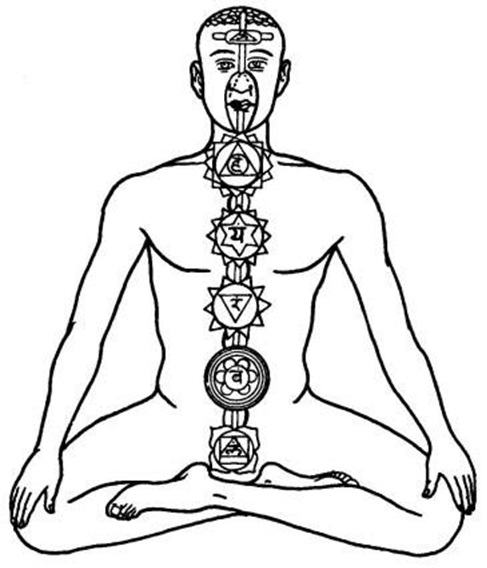
The spinal cord is a column of very soft grey and white brain-matter. The white matter is arranged on the sides of the grey matter. The white matter is of medullated nerves while the grey is of nerve-cells and fibres. This is not tightly fitted with the spinal canal, but suspended or dropped, as it were, into the spinal canal just like the brain in the cranial cavity. This is nourished by the membranes. Spinal cord and brain float in the cerebro-spinal fluid. The fluid prevents, therefore, any injury done to them. Further the spinal cord is protected by a covering of fatty tissue. It is divided into two symmetrical halves by an anterior and posterior fissure. In the centre there is a minute canal, called canalis centralis. Brahmanadi runs along this canal from the Muladhara to Sahasrara Chakra. It is through this Nadi, Kundalini, when awakened, passes to Brahmarandhra.
When we study the construction, location and function of the Spinal Cord and the
Sushumna Nadi, we can readily say that the Spinal Cord was called Sushumna Nadi by the Yogins
of yore. The Western Anatomy deals with the gross form and functions of the Spinal Cord, while
the Yogins of ancient times dealt with all about the subtle (Sukshma) nature. Now in Kundalini
Yoga, you should have a thorough knowledge of this Nadi.
Sushumna extends from the Muladhara Chakra (second vertebra of coccygeal region) to
Brahmarandhra. The Western Anatomy admits that there is a central canal in the Spinal Cord,
called Canalis Centralis and that the cord is made up of grey and white brain-matter. Spinal Cord is
dropped or suspended in the hollow of the spinal column. In the same way, Sushumna is dropped
within the spinal canal and has subtle sections. It is of red colour like Agni (fire).
Within this Sushumna there is a Nadi by name Vajra which is lustrous as Surya (sun) with
Rajasic qualities. Again within this Vajra Nadi, there is another Nadi, called Chitra. It is of Sattvic
nature and of pale colour. The qualities of Agni, Surya and Chandra (fire, sun and moon) are the
three aspects of Sabda Brahman. Here within this Chitra, there is a very fine minute canal (which is
known as Canalis Centralis). This canal is known as Brahmanadi through which Kundalini, when
awakened, passes from Muladhara to Sahasrara Chakra. In this centre exist all the six Chakras
(lotuses, viz., Muladhara, Svadhishthana, Manipura, Anahata, Vishuddha and Ajna).
The lower extremity of the Chitra Nadi is called Brahmadvara, the door of Brahman, as
Kundalini has to pass through this door to Brahmarandhra. This corresponds to Haridwar which is
the gate of Hari of Badrinarayan in the macrocosm (physical plane). The Chitra terminates in the
Cerebellum.
In a general sense the Sushumna Nadi itself (gross Spinal Cord) is called Brahma Nadi
because, Brahma Nadi is within the Sushumna. Again the canal within the Chitra is also called
Sushumna, because the canal is within the Sushumna. Ida and Pingala Nadis are on the left and right
sides of the spine.
Chitra is the highest and most beloved of the Yogins. It is like a thin thread of lotus. Brilliant
with five colours, it is in the centre of Sushumna. It is the most vital part of the body. This is called
the Heavenly way. It is the giver of Immortality. By contemplating on the Chakras that exist in this
Nadi, the Yogi destroys all sins and attains the Highest Bliss. It is the giver of Moksha.
When the breath flows through Sushumna, the mind becomes steady. This steadiness of the
mind is termed “Unmani Avastha”, the highest state of Yoga. If you sit for meditation when
Sushumna is operating, you will have wonderful meditation. When the Nadis are full of impurities,
the breath cannot pass into the middle Nadi. So one should practise Pranayama for the purification
of Nadis.
Ida and Pingala Nadis are not the gross sympathetic chains. These are the subtle Nadis that carry the Sukshma Prana. In the physical body these tentatively correspond to the right and left sympathetic chains.
Ida starts from the right testicle and Pingala from the left testicle. They meet with Sushumna Nadi at the Muladhara Chakra and make a knot there. This junction of three Nadis at the Muladhara Chakra is known as Mukta Triveni. Ganga, Yamuna and Sarasvati dwell in Pingala, Ida and Sushumna Nadis respectively. This meeting place is called Brahma Granthi. Again these meet at the Anahata and Ajna Chakra. In the macrocosm also you have a Triveni at Prayag where the three rivers Ganga, Yamuna and Sarasvati meet.
Ida flows through the left nostril and Pingala through the right nostril. Ida is also called Chandra Nadi (moon) and Pingala as Surya Nadi (sun). Ida is cooling and Pingala is heating. Pingala digests the food. Ida is of pale, Sakti Rupa. It is the great nourisher of the world. Pingala is of fiery red, Rudra Rupa. Ida and Pingala indicate Kala (time) and Sushumna swallows time. The Yogi knows the time of his death; takes his Prana into Sushumna; keeps it in Brahmarandra, and defies time (Kala—death). The famous Yogi Sri Chang Dev of Maharashtra fought against death several times by taking the Prana into Sushumna. He was a contemporary of Sri Jnanadev of Alandi, near Poona. It was he who had Bhuta Siddhi, control over wild animals, through his Yogic practices. He came on the back of a tiger to see Sri Jnanadev.
Svara Sadhana, practice of breath, is the revealer of Satya, Brahman and bestower of the Supreme Knowledge and Bliss. Perform calm acts during the flow of Ida and harsh acts during the flow of Pingala. Do acts resulting in the attainment of psychic powers, Yoga, meditation, etc., during the flow of the Sushumna. If the breath rises by Ida (moon) at sunrise and flows throughout the day, and Pingala (sun) rises at sunset and flows throughout the night it confers considerable good results. Let the breath flow through Ida the whole day and through Pingala the whole night. He who practises thus is verily a great Yogi.
Correct breath flow improves health and spiritual progress.
Gandhari, Hastajihva, Kuhu, Sarasvati, Pusha, Sankhini, Payasvini, Varuni, Alambusha, Vishvodhara, Yasasvini, etc., are some other important Nadis. These have their origin in Kanda. All these Nadis are placed on the sides of Sushumna, Ida and Pingala, and proceed to different parts of the body to perform certain special functions. These are all subtle Nadis. Innumerable minor Nadis spring from these. As the leaf of the Asvattha tree is covered with minute fibres so also, this body is permeated with thousands of Nadis.