“Regulation of breath or the control of Prana is the stoppage of inhalation and exhalation, which follows after securing that steadiness of posture of seat.” This is the definition of Pranayama in the Yogasutras of Patanjali.
Svasa’ means inspiratory breath. ‘Prasvana’ means expiratory breath. You can take up the practice of Pranayama after you have gained steadiness in your Asana (seat). If you can sit for 3 hours in one Asana, continuously at one stretch, you have gained mastery over the Asana. If you are able to sit from half to one hour even, you can take up the practice of Pranayama. You can hardly make any spiritual progress without the practice of Pranayama.
Prana is Vyashti, when the individual is concerned. The sumi total of the cosmic energy or cosmic Prana is Hiranyagarbha who is known as the floating “Golden Egg.” Hiranyagarbha is Samashti Prana. One match stick is Vyashti (single). The whole match box is Samashti. A single mango-tree is Vyashti. The whole mango grove is Samashti. The energy in the body is Prana. By controlling the motion of the lungs or respiratory organs, we can control the Prana that is vibrating inside. By control of Prana, the mind can be easily controlled, because the mind is fastened to the Prana, like the bird to the string. Just as the bird that is tied to a post by a string, after flying here and there, finds its resting place in the post, so also this mind-bird after running hither and thither, in various sensual objects, finds its resting place during deep sleep in the Prana.
Others offer Prana (outgoing breath) in Apana (incoming breath) and Apana in Prana, restraining the passage of Prana and Apana, absorbed in Pranayama. Pranayama is a precious Yajna (sacrifice). Some practice the kind of Pranayama called Puraka (filling in). Some practise the kind of Pranayama called Rechaka (emptying).
Some are engaged in the practice of Pranayama called Kumbhaka, by impeding the outward passage of air, through the nostrils and the mouth, and by impeding the inward passage of the air, in the opposite direction. “Pranayama is the control at the life-forces by realising naught but Brahman in all things as the mind, etc.”
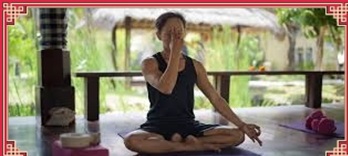
The first important step is to master the Asana or posture or to control the body. The next exercise is Pranayama. Correct posture is indispensable requisite for the successful practice of Pranayama. Aneasy comfortable posture is Asana. That pose is the best which continues to be comfortable for the greatest length of time. Chest, neck and head the body either forwardsor laterally i.e., either on the right or left side. You should not sit crocked. You should not allow the body to collapse. You must not bend the body either forwards or backwards. By regular practice the mastery over the pose will come by itself. Fatty people will find it difficult to practise the Padma Asana or the Lotus Pose. They can sit on the Sukha Asana (comfortable pose). You need not wait for practising Pranayama also. In course of time, you will acquire perfection in both. Pranayama can also be practised by sitting in the chair erect.
In Bhagavad Gita, the Immortal Song of Lord Krishna, you will find a beautiful description of seat and pose. “In a pure secreat place by himself established in a fixed seat of his own, neither too high nor too low, with cloth, black antelope-skin and Kusagrass one over the other, there, making the mind one-pointed, with thought and the functions of the senses controlled, steady on his seat, he should practise Yoga for the purification of the Self, holding the body, head and neck erect, firm, gazing steadily at the tip of the nose without looking around”.
Pranayama is the control of the Prana and the vital forces of the body. It is regulation of the breath. This is the most important step. The aim of Pranayama is the control of Prana. Pranayama begins with the regulation of the breath for having control over the life-currents or inner vital forces. In other words, Pranayama is the perfect control of the lifecurrents through control of breath. Breath is external manifestation of the gross Prana. A correct habit of breathing must be established by the regular practice of Pranayama. In ordinary worldly persons the breathing is irregular. If you can control the Prana you can completely control all the forces of the Universe, mental and physical. The Yogi can also control the
Omnipresent manifesting power out of which all energies take their origin, whether concerning magnetism, electricity, gravitation, cohesion, nerve-currents, vital forces or thought-vibrations, in fact the total forces of the Universe, physical and mental.
Pranayama gives strength, vitality, good health, concentration and longevity.
Average breathing is 21,600 breaths per day.
Pranayama is regarded lengthy or subtle according to its three components, the external, the internal and the steady; the retention processes are modified by the regulations of space, time and number,
When the breath is expired, it is Rechaka, the first kind of Pranayama. When the breath is drawnin, it is the second, termed Puraka. When it is suspended, it is the third kind, called Kumbhaka increases the period of life. It augments the inner spiritual force, vigour and vitality. If you retain the breath for one minute, this one minute is added to your span of life. Yogins by taking the breath to the Brahmarandhra at the top of the head and keeping it there, defeat the Lord of death, Yama, and conquer death. Chang Dev lived for one thousand and four-hundred years through the practice of Kumbhaka. Each of these motions in Pranayama viz., Rechaka, Puraka and Kumbhaka,
is regulated by space, time and number. By space is meant the inside or out-side of the body and the particular length or the breadth and also when the Prana is held in some particular part of the body. During expiration respectively 12, 16, 4, 8, 0, fingers’ breaths according to the Tattvas-Prithvi, Apas, Tejas, Vayu or Akasa (earth, water, fire, air or ether). This is again external during exhalation and internal during inhalation.
Time is, the time of duration of each of these, which is generally counted by Matra, which corresponds to one second. Matra means a measure. By time is also meant how long the Prana should be fixed in a particular centre or part.
Number refers to the number of times the Pranayama is performed. The Yogic student should showly take the number of Pranayamas to eighty at one sitting. He should have four sittings in morning, afternoon, evening and midnight, or at 9 p.m., and should have thus 320 Pranayamas in all. The effect or fruit of Pranayama is Udghata or awakening of the sleeping Kundalini. The chief aim of Pranayama is to unite the Prana with the Apana and take the united Pranayama slowly upwards the head.
Kundalini is the source for all occult powrs. The Pranayama is long or short according to the period of time, it is practised. Just as water, thrown on a hot pan shrivels upon all sides as it is being dried up, so also the air, moving in or out ceases its action by a strong effort of restraint (Kumbhaka) and stays within. Vachaspati describes-“Measured by 36 Matras, is the first attempt (Udghata), which is mild. Twice that is the second, which is middling. Thrice that is the third, which is the intense. This is the Pranayama as measured by number.”
The ‘place’ of exhalation lies within 12 (inches) inches of the tip of nose. This is to be ascertained through a piece of reed or cotton. The place of inhalation ranges from the head down to the soles of the feet. This is to be ascertained through a sensation similar to the touch of an ant. The place of Kumbhaka consists of the external and internal places of both exhalation and inhalation taken together, because the funcitons of the breath are capable of being held up at both these places. This is to be ascertained through the absence of the two indicatives noted above, in connection with exhalation and inhalation.
The specification of the three kinds of breath-regulations, by al these three-time, space and number-is only optional. They are not to be understood as to be practised collectively, for in many Smiritis we meet with passages, where the only specification mentioned with reference to the regulation of breath is that of time. The fourth is restraining the Prana by directing it to external or internal object.
This fourth Pranayama is carried further. It concerns with the fixing of the Prana in the various lotuses (Padmas or Chakras) and taking it slowly, and slowly, step by step, and stage by stage to the last lotus in the head, where perfect, Samadhi takes place. This is internal. Externally it takes in consideration the length of breath in accordance with the prevailing Tattva. Prana can be directed either inside or outside.
Adhama – 12 Matras Madhyama – 24 Matras Uttama – 32 Matras
Ratio: Puraka : Kumbhaka : Rechaka = 1 : 4 : 2
Being without any distraction and with a calm mind, one should practise Pranayama. Both expiration and inspiration should be stopped. The practitioner should depend solely on Brahman; that is the highest aim of life. The giving out of all external objects, is said to be Rechaka.
The taking in of the spiritual knowledge of Sastras, is said to be Puraka and the keeping to oneself of such knowledge is said to be Kumbhaka. He is an emancipated person who practises his Chitta thus. There is no doubt about it. Through Kumbhaka the mind should always be taken up and through Kumbhaka alone it should be filled up within. It is only through Kumbhaka that Kumbhaka should be firmly mastered. Within it, is “Parama-Siva”.
At first in his Brahmagranthi there is produced soon a hole or passage. Then having pierced Brahmagranthi, he pierces Vishnugranthi, then he pierces Rudragranthi, then the Yogin attains his liberation through the religious ceremonies, performed in various births, through the grace of gurus and Devatas and through the practice of Yoga.
Purification of Nadis is essential before Pranayama.
The Vayu cannot enter the Nadis if they are full of impurities. Therefore, first of all, they should be purified and then Pranayama should be practised. The Nadis are purified by two processes viz., samanu and Nirmanu. The Samanu is done by a mental process with Bija Mantra. The Nirmanu is done by physical cleansing or the Shatkarmas.
1. Sit on Padmasana. Meditate on the Bijakshara of Vayu (Yam) which is of smoke colour. Inhale through the left nostril. Repeat the Bijakshara 16 times. This is Puraka. Retain the breath till you repeat the Bija 64 times. This is Kumbhaka. Then exhale through the nostril very very slowly till you repeat the Bijakshara 32 times.
2. The naval is the seat of Agnitattva. Meditate on this Agnitattva. Then draw the breath through the right nostril repeating 16 times the Agni Bija (Ram). Retain the breath, till you count the Bija 64 times. Then exhale slowly through the leftnostril till you repeat mentally the Bija letter 32 times.
3. Fix the gaze at the tip of the nose. Inhale through the left nostril repeating the Bija (Tham) 16 times. Retain the breath till you repeat the Bija (Taham) 64 times. Now imagine that the nectar that flows from the moon runs through all the vessels of the body and purifies them. Then exhale slowly through right nostril till you repeat the Prithvi (Lam) 32 times.
The Nadis ate purified nicely by the practice of the above three kinds of Pranayama by sitting firmly in your usual posture.